miércoles, 30 de junio de 2010

The Andy Warhol Story (1966) lost film/ The Chelsea Girls


THE ANDY WARHOL STORY (1966)

to DEC. 1965: EDIE SEDGWICK MAKES HER LAST ANDY WARHOL FILM (SORT OF)

Edie Sedgwick/Rene Ricard (as Andy Warhol)filmed November 1966 (LD260)
The Andy Warhol Story is one of Warhol's "lost" films - mentioned in a few sources, but largely unknown and unseen. Although Lupe is generally credited as Edie Sedgwick's final Warhol film, The Andy Warhol Story is actually the last film that Edie Sedgwick made for Andy Warhol - almost a year after Lupe.
After Lupe, Edie left the Warhol crowd for the Dylan crowd - with Dylan's manager hoping to turn her into a singer and/or actress. However the plans never materialized and Sedgwick started visiting the Factory again "asking for pills and money". According to Victor Bockris, "Andy always gave her a few dollars and an Obetrol if he had a spare one on him" and "put her in one last movie, to try, as he said, to 'help her out'." (LD260) (Warhol, himself, always denied giving drugs to Edie.)
Paul Morrissey:
"Rene Ricard was supposed to be Andy and Edie was in it with him. She was in a bad way, and we thought we could help her, even though she had been so mean to do what she did [leaving Warhol]. Andy really liked her and I did too. We thought it might work, but it wasn't any good. All Rene did was look in the camera and say nasty things about Andy, and it was really embarrassing because he thought he'd be funny. I remember very well Andy just not finding it funny at all, but anybody else in that circumstance would have turned the camera off and he wouldn't." (LD26)
According to Rene Ricard, it was Rene who insisted on using Edie Sedgwick in the film:
Rene Ricard:
"I made a film with Edie about nine months after she left the Factory. Andy suggested, 'Let's do a movie with you as me in it. The Andy Warhol Story.
I really hated Andy by then. I realized his was a passive exploitation - that it could be humiliating and horrible. He had been asking me to do this for a long time and I had refused. But one night I took an Obetrol - a very powerful twenty five milligram amphetamine pill, the best. They were very hard to get, rare and very good.
It's a good high, very gay, very lovely speed.
That night we were making this Tiger Morse movie, part of a twenty-four hour four-star movie in which I was supposed to be an extra. 'Don't do too much talking', I was told. Well, the pill got me hysterical and I was amazingly good at it. Andy fell in love with me for it. Once again he said, 'Oh, you're so good tonight; let's do that movie I've wanted you to do.'
So I finally said okay. The only reason I agreed to do his film was to get even with him.
I said, 'Okay, let's go to my place and do it.' I was living in a very beautiful apartment on Fifth Avenue with Avery Dunphy, who was being kept in this luxurious place by a doctor who was mad for prissy Wasps. Mirrored coffee tables, a huge white silk-satin couch.Beautiful, right? What Avery wanted to be was chic -which was all anybody wanted at that time. Having Andy Warhol make a movie in that apartment, even though it wasn't his, was very chic. I called Avery and told him what was happening - that we were on the the way. I told him, 'I want orchids. I want the place filled with orchids.'
He asked, 'Well, where am I going to get orchids at this time of night?'
I told him about a place in the East Sixties that's openuntil mid-night. I figured I'd do it right. Right? I didn't have any money, but at least I could have orchids.
Besides, I was trying to get even with Andy. So Avery went out and bought the most exquisite orchids you've ever seen. He bought orchids to die over. I know the difference between good orchids and vulgar ones, and these were expensive and good - from Hawaii or Vietnam, which is where Paris gets its orchids.
When we all got to the apartment, Andy asked, 'Who do you want in the film with you?' I said 'I only want Edie Sedgwick. Who else is there in your life but Edie Sedgwick?' Andy said, 'I don't know if we can get her.' I said, 'I won't do it without her.'
I took another pill and I got wired. Wired! There's a point when you take speed when you talk a lot, and yet there's also a point where you take too much and you don't talk. That's the point that second pill got me to.
So Andy got Edie on the telephone and offered to pay for her taxi, and about three hours later Edie turned up. I didn't want to make the movie when I saw her. She was wearing a dirty blond fall. She looked like the cheapest piece of filth.
Here was my Edie, my Edie, and I was making a movie with her - co-stars! No longer was I an extra, and she looked like hell! She was wearing a kind of Marimekko type dress, and mean! She, too, hated Andy at that point: she had been eighty-sixed.
When she was with the fairies, she was on speed and she was Edie, she was 'on'. When she was with Bobby Neuwirth, who was a hetero, she was on downs, and Edie on downs was not pretty.
Well, when she arrived at the apartment, the cameras started rolling. I had my own personal vendetta against against Warhol, and so did she. And I was playing Warhol. So I played him the way he behaved to the people under him. She played herself according to how she felt about him then. The things she said to me were horrible. I don't remember them. I don't even remember what I said. I was awful. I have nightmares about what I did in that movie... saying things about Andy that were true, how he disposed of people.
Paul Morrissey, who was behind the camera, was white with rage. I went through the paintings... how Andy doesn't actually do the paintings himself. Stupid things like: "Gerard get me an egg. Do you want to know howI paint my pictures, you people out there?' I'd crack the egg in a glass and then I'd say to Gerard: 'Cook it!' That's how I paint my pictures.'
We did one reel and stopped. Then Andy in his sick, masochistic, dreadful way - after all, here were these two people on camera saying the most ghastly things about him - said 'Let's do another reel.' He had been standing holding his fingers in his mouth, which he does when he's anxious, and he was loving it... getting the truth.
So we did another reel, and in this one it got violent. Edie started it. At some point I gave her some orchids. I said, 'You're not dressed up enough for this movie. So do something. Take these flowers.'
She took them and crushed them. I got very upset. And I - me, Rene Ricard, not the Andy Warhol me - was just made demented by that. I love orchids. It was a personal thing from me to her. I said, 'You really need to fix yourself up, my dear. Put them on you somewhere.'
She cried out, 'I hate them! I don't want to be beautiful!'She wrecked the flowers. Edie was hating me. We were both hating each other because of the roles we were playing... I loved Edie, but I couldn't stand being in a movie with her the way she looked. She was horrible in the movie, and mean. The things I was saying were so horrible.
Paul Morrissey suddenly reached out from behind the camera and ripped my clothes off me - a new white silk shirt and new pair of white linen pants. He ripped them. The camera was turning. Paul was out of the frame. I guess he was livid because of the things I was saying about Andy.
So we finished the film - two reels. Edie rushed home. I didn't care about her at that point. My clothes were a ruin. I was a mess. I was wiped out by the pills. Dazed.
You'll never guess what happened then. Andy Warhol at that point was close to a guy called Rod La Rod. He was handling the sound on this film. They asked me to see the rushes in the Factory. I sat there watching it - Paul, Andy, Rod and a few of the other serfs were there -and I saw what they had done to it. Edie's voice is there, but when I speak, you can't hear it. They were in glee." (EDIE285-7)
According to Victor Bockris in his book on Warhol, Edie looked "as tawdry as Ingrid Superstar" and "the movie was such a torturous document of Edie's disintegration that the one time it was shown at the Factory, those watching begged Andy to turn it off." (LD260)
The Andy Warhol Story is also mentioned by Callie Angell as part of the Andy Warhol Film Project under the auspices of the Whitney Museum of Modern Art. According to Callie, Edie "apparently appeared in The Andy Warhol Story (or Rene as Andy), an unreleased and reportedly vicious two-reel feature made in 1966, in which both Rene Ricard and Edie pretend to be Andy Warhol." (FAW25)


THE CHELSEA GIRLS (1966) to SUMMER 1966: ANDY WARHOL SHOOTS THE CHELSEA GIRLS
B/W & Color/16mm/sound/24fps3 hrs. 15 mins (split screen)(filmed summer 1966)(two segments scripted by Ronald Tavel)
Marie Menken/Mary Woronov/Gerard Malanga/International Velvet (Susan Bottomly)/Ingrid Superstar/Angelina "Pepper" Davis/Ondine (Bob Olivio)/Albert Rene Ricard/Ronna Page/Ed Hood/Patrick Fleming/Mario Montez/Eric Emerson/Ari Boulogne/Brigid Berlin
Music: The Velvet Underground/Lighting: Paul Morrissey & Billy NameCamera: Andy Warhol/Executive Producer: Paul MorrisseyProducer: Andy Warhol/Video Version: Paul Morrissey(video version copyrighted 1993 by The Andy Warhol Foundation for the Visual Arts, Inc. and Paul Morrissey)


The Chelsea Girls was Andy Warhol's his first major commercial success and catapulted many of the participants into superstardom - Ondine, Nico, International Velvet (Susan Bottomly), Brigid Berlin and Mary Woronov. When Mary Woronov's mother saw the film she sued Warhol because her daughter had not signed a release. Warhol eventually paid all the actors $1,000.00 each to sign a release. (DB)
The Chelsea Girls is made up of various scenes shot at the Chelsea Hotel, the Factory and at various apartments including the Velvet Underground's apartment on West 3rd Street in the Village. Nico, Brigid Berlin and Susan Bottomly (International Velvet) lived at the Chelsea Hotel at the time the film was made. Brigid said that she spent about one night a week in her own room and the rest of the time visiting other people in other rooms. (DB240)
At the premiere of the film at Jonas Mekas' Cinematheque, the film sequences were listed on the program accompanied by fake room numbers at the Chelsea Hotel. These had to be removed, however, when the Chelsea Hotel threatened legal action.
At least two of the segments listed in the original program for The Chelsea Girls were deleted from the film - The Afternoon and The Closet. The Closet starred Nico and Randy Bourscheidt and is now shown as a separate film.
The Afternoon starred Edie Sedgwick. According to Paul Morrissey, Edie later asked for her footage to be taken out of The Chelsea Girls, saying that she had signed a contract with Bob Dylan's manager, Albert Grossman. (EDIE283)
The Their Town segment of The Chelsea Girls featured a script by Ron Tavel based on an article, "The Pied Piper of Tucson," in Life Magazine in March 1966 about a serial killer. (AD30)
Nico, Brigid Berlin and Susan Bottomly (International Velvet) lived at the Chelsea at the time The Chelsea Girls was made. Brigid said that she spent about one night a week in her own room and the rest of the time visiting other people in other rooms. (DB240)
Ronna Page, the person who Ondine verbally and physically assaulted in The Chelsea Girls, was actually a friend of Jonas Mekas who had sent her to the Factory. She also hung around with Gerard Malanga and appeared in Warhol's film Bufferin with Malanga. She accompanied Gerard to poetry readings as well as appearing onstage with the Exploding Plastic Inevitable when they played the Boston ICA in 1966. (GMW56-9)
Warhol shot the footage for The Chelsea Girls from June to September 1966. It was generally improvised except for two scripts sent in by Ron Tavel who mailed the scripts to Warhol from Los Angeles - one being the "Hanoi Hannah" segment featuring Mary Woronov. In August 1966, Jonas Mekas asked Warhol for a film to screen and Paul Morrissey and Warhol assembled 12 of the films they had shot into The Chelsea Girls. According to Victor Bockris the reels of film were shown on two screens in order to reduce the time of the film from 6 1/2 hours to 3 hours 15 minutes. (LD256)
The Chelsea Girls opened at the 200 capacity Film-Makers' Cinematheque on September 15, 1966. It returned there for a second week from October 19 - 25, and again from November 6 - 9, with many of the performances sold out. Due to the film's popularity, the Film-Maker's Distribution Center (FDC) booked the six-hundred seater Cinema Rendevous at 110 West 57th Street to show the film. The FDC had been founded by Jonas Mekas and his underground film cronies in order to distribute underground films to commercial theatres.
On December 1, 1966, The Chelsea Girls opened at the Cinema Rendezvous - "making it the first underground movie to get a two-week run in a midtown Manhattan art theater." (DB248) The estimated investment for the release was $ 15,000, which included cinema rental, advertising and publicity expenses. It netted $5,000 for this screening which was split equally between the FDC and Warhol. After its run at the Rendezvous, it was moved to the Regency Theater of Broadway at 67th Street, playing three daily performances for more than a month. It then moved to the York Cinema on the East Side, with the FDC making arrangements with the Art Theater Guild who had art house cinemas throughout the country. (DB249)
The film cost approximately $1,500 - $3,000 to make and in its first nineteen weeks of release in New York, it grossed approximately $130,000 at the box office. Following reviews of the film in the national press, it was booked into cinemas in Los Angeles, Dallas, Washington, San Diego and Kansas City. (DB249) When the film played Boston, the cinema was raided by the vice squad and the manager found guilty of four charges of obsenity and fined $500.00 for each charge. According to David Bourdon, Andy was "delighted" as it meant that he would be able to say that the film had been "banned in Boston" - "traditionally a publicist's dream." (DB254)
When the film was initially released, Newsweek praised it as the "Iliad of the underground". Not all reviews were so favourable however. Rex Reed said, "Chelsea Girls is a three and a half hour cesspool of vulgarity and talentless confusion which is about as interesting as the inside of a toilet bowl." (LD258)
Gary ComenasWarholstars


POOR LITTLE RICH GIRL (1965)
to JUNE 19/20, 1965: POOR LITTLE RICH GIRL PREMIERES AT ASTOR PLACE PLAYHOUSE

BW/Sound/66 mins at 24 fpsEdie Sedgwick and Chuck Wein (off screen)(filmed March-April 1965)
Andy Warhol:
"Whatever anyone may have thought, the truth is I never gave Edie a drug, ever. Not even one diet pill. Nothing. She certainly was taking a lot of amphetamine and downs, but she certainly wasn't getting them from me. She was getting them from that doctor who was shooting up every Society lady in town." (POP108)
Poor Little Rich Girl was originally conceived as part of a series of films featuring Edie Sedgwick which Warhol started shooting in March 1965 called The Poor Little Rich Girl Saga. It included Restaurant, Face, and Afternoon, as well as this film. The title is the same as a 1936 movie starring Shirley Temple who Andy idolized in his childhood. (FAW20)
The film takes place in Edie's apartment. Andy and Gerard shot two rolls (approx. 70 mins) of Edie as "she lay on her bed, talked on the phone and walked around her room, showing off her clothes and describing how she had spent her entire inheritance in six months." (L&D221)
When the rolls were processed, they were completely out of focus because of a problem with the camera lens. They re-shot the two long takes, adding it to the first reel so that the first 33 minutes of the film are completely out of focus as Edie wakes up, orders coffee and orange juice, smokes cigarettes does her excercises, takes pills and puts on make-up - all done in silence, except for the background music of an Everly Brothers album. (FAW22/L&D221


EMPIRE (1964)
to JULY 25 - 26, 1964: ANDY WARHOL FILMS EMPIRE
BW/Silent/8 hrs, 5 mins/16 fps(filmed July 25/26,
1964)
Mary Woronov (2008):
"Okay. It's freezing in New York. I'm staying at the Gershwin, a MIdtown hotel straight out of Raymond Chandler. They are having a Warhol festival, everyone gets a free silver wig and a pair of Wayfarer sunglasses. All week, there are two to three of Andy 's early black-and-white films running 24/7 on the lobby walls. It's 2 a.m. and on the wall beside me is the Empire State Building. I want to go to bed, but instead, I sit down and my brain floods with feelings about the past when Daddy took us to the top of the tallest building in the world, about America, my tragic country that was great but is not great anymore, and about the city I can no longer afford to live in. All this takes about three seconds because I promised myself a long time ago I would never cry in a hotel lobby. But the building continues to demand my attention. And, unlike a painting, it is not dead. It's living, like a window that sees only the past. 'This is brilliant,' I blurt out, and four different people tell me to shut the fuck up. But my brain is bubbling over. I realize that Andy never meant to do a film. he was doing a painting. Pop art put the image back in painting and Andy took it even further and put the image on film instead of canvas. He wasn't directing, he was painting. It's only taken me 40 years to realize that these films were never meant to screen in a theater, where I thought they were boring. They were meant to hang on a wall. They are Andy's greatest paintings." (MX)


Empire was filmed on the night of July 25-26 from 8:06 pm to 2:42 am, from the offices of the Rockefeller Foundation on the 41st floor of the Time-Life building. According to Gerard Malanga, "It was John Palmer who came up with the idea for Empire. John, Jonas Mekas and I changed the reels for Andy. He barely touched the camera during the whole time it was being made. He wanted the machine to make the art for him."(L&D207/FAW16/www.moma.org/collection/depts/film_media/blowups/film_media_023.html)
Gerard Malanga:
"On a somewhat hazy afternoon - Saturday, to be exact, 25 July 1964 - a group - Andy Warhol, Gerard Malanga, Jonas Mekas, Marie Desert, and John Palmer - enter the Time-Life Building, corner of 50th/Avenue of the Americas, with bags and boxes of camera equipment in tow, and ascend to the 44th floor headquarters of the Rockefeller Foundation, to be met at the front door by Henry Romney, a Vice-president of the foundation. Henry ushers us into his office, which offers an unobstructed view of the Empire State Building, 16 blocks to the southeast. After a few minutes of schmoozing, we begin breaking out the equipment, separating cables, film-loading bags, tripod, and boxes of Eastman Kodak raw stock, and with meticulous care, fix the Auricon camera onto the tripod's metal plate. This is the first time Andy would make use of this highly professional, though antiquated piece of equipment." (GMW85)
The film begins with a totally white screen and as the sun sets, the image of the Empire State Building emerges. The floodlights on its exterior come on, the building's lights flicker on and off for the next 6 1/2 hours, then the floodlights go off again in the next to the last reel so that the "remainder of the film takes place in nearly total darkness." (FAW16)
According to Gerard Malanga, the first two reels were actually overexposed because "Andy was exposing for night light, but it was all guesswork." (L&D207)
Andy used a camera with sync sound for the first time in Empire. According to Victor Bockris, Jonas Mekas "had brought the Auricon newsreel camera he had just used to film the Living Theater's production of The Brig. (L&D207). According to Gerard Malanga , the Auricon had been rented from F & B Ceco on West 43rd Street - the rental arranged by John Palmer. (GMW90)
Gerard Malanga:
"The Auricon, a 16mm single-system sound camera, had the distinct advantage of accommodating a 1200-foot magazine, allowing for a 35-minute take at the flick of a switch. Ironically, the camera was chosen not for its sound capacity, but in cutting time while reels were being changed to assimilate the nearly exact ratio of reel time to real time, as first theorized by John [Palmer] - '1 to 1' - adhering to a Warholian principle already established to an initial degree with the film, Sleep a year earlier." (GMW90)
Empire was originally intended to be a sound movie with Henry Geldzahler, Gerard Malanga, Jonas Mekas and John Palmer talking in the background. (L&D206) John Palmer had been a student at the same college as Gerard Malanga - the Wagner Memorial Lutheran College, Staten Island, New York. During his senior year in 1963, Gerard was editor of the college's literary magazine and John Palmer had contributed some writing. John Palmer would later go on to direct and write (along with David Weisman), the non-Warhol film, Ciao Manhattan starring Edie Sedgwick.
Gerard Malanga:
"John Palmer, a young filmmaker, should rightly be credited with the concept for the film, Empire. It was John's ingenuity and proficiency that most impressed Warhol to go ahead and rent the movie camera needed to see this project through. John was considered something of a 'wunderkind' among the underground filmmakers, like Ron Rice, Jack Smith, and Harry Smith... It was also through John's acquaintance with Henry Romney, that we would secure Henry's office for the making of the movie. John had met Henry through Frederick Eberstadt, a society photographer he assisted shortly after arriving in New York from Hartford, fresh out of high school." (GMW88/90)
During the filming, the lights in the office from which they were shooting were temporarily left on. In the beginning of three reels, images of the film crew can be seen reflected in the window, next to the Empire State Building. Warhol's reflection appears at the beginning of Reel 7. (FAW17)To "break the monotony" of the filming, Gerard Malanga "decided to notate a few minutes worth of conversation verbatim".
Gary ComenasWarholstars

Fuente de todas las reseñas: www.warholstars.com

lunes, 28 de junio de 2010

Pop art en el mundo

Pop art


Richard Hamilton's collage Just What Is It That Makes Today’s Homes So Different, So Appealing? (1956) is one of the earliest works to be considered "pop art".

Pop art is an art movement that emerged in the mid 1950s in Britain and in the late 1950s in the United States. Pop art challenged tradition by asserting that an artist's use of the mass-produced visual commodities of popular culture is contiguous with the perspective of fine art. Pop removes the material from its context and isolates the object, or combines it with other objects, for contemplation. The concept of pop art refers not as much to the art itself as to the attitudes that led to it.

Pop art is an art movement of the twentieth century. Characterized by themes and techniques drawn from popular

mass culture, such as advertising, comic books and mundane cultural objects, pop art is widely interpreted as a reaction to the then-dominant ideas of abstract expressionism, as well as an expansion upon them. Pop art, aimed to employ images of popular as opposed to elitist culture in art, emphasizing the banal or kitschy elements of any given culture, most often through the use of irony. It is also associated with the artists' use of mechanical means of reproduction or rendering techniques.
Much of pop art is considered incongruent, as the conceptual practices that are often used make it difficult for some to readily comprehend. Pop art and minimalism are considered to be art movements that precede postmodern art, or are some of the earliest examples of Postmodern Art themselves.

Pop art often takes as its imagery that which is currently in use in advertising. Product labeling and logos figure prominently in the imagery chosen by pop artists, like in the Campbell's Soup Cans labels, by Andy Warhol. Even the labeling on the shipping carton containing retail items has been used as subject matter in pop art, for example in Warhol's Campbell's Tomato Juice Box 1964, (pictured below), or his Brillo Soap Box sculptures.

Origins

The origins of pop art in North America and Great Britain developed differently.[2] In America, it marked a return to hard-edged composition and representational art as a response by artists using impersonal, mundane reality, irony and parody to defuse the personal symbolism and "painterly looseness" of Abstract Expressionism.[3][6] By contrast, the origin in post-War Britain, while employing irony and parody, was more academic with a focus on the dynamic and paradoxical imagery of American popular culture as powerful, manipulative symbolic devices that were affecting whole patterns of life, while improving prosperity of a society.[6] Early pop art in Britain was a matter of ideas fueled by American popular culture viewed from afar, while the American artists were inspired by the experiences of living within that culture.[3] Similarly, pop art was both an extension and a repudiation of Dadaism.[3] While pop art and Dadaism explored some of the same subjects, pop art replaced the destructive, satirical, and anarchic impulses of the Dada movement with detached affirmation of the artifacts of mass culture.[3] Among those artists seen by some as producing work leading up to Pop art are Pablo Picasso, Marcel Duchamp, Kurt Schwitters, and Man Ray.

In Britain: The Independent Group

Eduardo Paolozzi. I was a Rich Man's Plaything (1947) is considered the initial standard bearer of “pop art” and first to display the word "pop". Paolozzi showed the collage in 1952 as part of his groundbreaking Bunk! series presentation at the initial Independent Group meeting in London.

The Independent Group (IG), founded in London in 1952, is regarded as the precursor to the pop art movement.[1][7] They were a gathering of young painters, sculptors, architects, writers and critics who were challenging prevailing modernist approaches to culture as well as traditional views of Fine Art. The group discussions centered around popular culture implications from such elements as mass advertising, movies, product design, comic strips, science fiction and technology. At the first Independent Group meeting in 1952, co-founding member, artist and sculptor Eduardo Paolozzi presented a lecture using a series of collages titled Bunk! that he had assembled during his time in Paris between 1947-1949.[1][7] This material consisted of 'found objects' such as, advertising, comic book characters, magazine covers and various mass produced graphics that mostly represented American popular culture. One of the images in that presentation was Paolozzi's 1947 collage, I was a Rich Man's Plaything, which includes the first use of the word “pop″, appearing in a cloud of smoke emerging from a revolver.[1][8] Following Paolozzi's seminal presentation in 1952, the IG focused primarily on the imagery of American popular culture, particularly mass advertising.[6]

Subsequent coinage of the complete term “pop art” was made by John McHale for the ensuing movement in 1954. “pop art” as a moniker was then used in discussons by IG members in the Second Session of the IG in 1955, and the specific term “pop art” first appeared in published print in an article by IG members Alison and Peter Smithson in Arc, 1956 [9]. However, the term is often credited to British art critic/curator, Lawrence Alloway in a 1958 essay titled The Arts and the Mass Media, although the term he uses is "popular mass culture" [10] Nevertheless, Alloway was one of the leading critics to defend the inclusion of the imagery found in mass culture in fine art.

In the United States

Roy Lichtenstein's Drowning Girl (1963) on display at the Museum of Modern Art, New York

Although the movement began in the late 1950s, Pop Art in America was given its greatest impetus during the 1960s. By this time, American advertising had adopted many elements and inflections of modern art and functioned at a very sophisticated level. Consequently, American artists had to search deeper for dramatic styles that would distance art from the well-designed and clever commercial materials. As the British viewed American popular culture imagery from a somewhat removed perspective, their views were often instilled with romantic, sentimental and humorous overtones. By contrast, American artists being bombarded daily with the diversity of mass produced imagery, produced work that was generally more bold and aggressive.

Two important painters in the establishment of America's pop art vocabulary were Jasper Johns and Robert Rauschenberg. While the paintings of Rauschenberg have relationships to the earlier work of Kurt Schwitters and other Dadaists, his concern was with social issues of the moment. His approach was to create art out of ephemeral materials and using topical events in the life of everyday America gave his work a unique quality. Johns’ and Rauschenberg’s work of the 1950s is classified as Neo-Dada, and is visually distinct from the classic American Pop Art which began in the early 1960s.

Of equal importance to American pop art is Roy Lichtenstein. His work probably defines the basic premise of pop art better than any other through parody. Selecting the old-fashioned comic strip as subject matter, Lichtenstein produces a hard-edged, precise composition that documents while it parodies in a soft manner.

The paintings of Lichtenstein, like those of Andy Warhol, Tom Wesselmann and others, share a direct attachment to the commonplace image of American popular culture, but also treat the subject in an impersonal manner clearly illustrating the idealization of mass production. Andy Warhol is probably the most famous figure in Pop Art. Warhol attempted to take Pop beyond an artistic style to a life style, and his work often displays a lack of human affectation that dispenses with the irony and parody of many of his peers.

Early exhibitions

Claes Oldenburg, Jim Dine and Tom Wesselmann had their first shows in the Judson Gallery in 1959/60. In 1960 Martha Jackson showed installations and assemblages, New Media - New Forms featured Hans Arp, Kurt Schwitters, Jasper Johns, Claes Oldenburg, Robert Rauschenberg, Jim Dine and May Wilson. In 1961 Oldenburg created a store for Martha Jackson's spring show Enviroments, Situations, Spaces. In December he showed The Store at his studio. Jim Dine's Car Crash happened at the Rubin Gallery on November 1, 1960.

In London the annual RBA exhibition of young talent in 1960 first showed American Pop influences. In January 1961 the most famous RBA-Young Contemporaries of all put David Hockney, the American R B Kitaj, Allen Jones, Derek Boshier, Patrick Caulfield, Peter Phillips and Peter Blake on the map. Hockney, Kitaj and Blake went on to win prizes at the John-Moores-Exhibition in Liverpool in the same year.

Late in 1962 Willem de Kooning's New York art dealer, the Sidney Janis Gallery, organized the groundbreaking International Exhibition of the New Realists, a survey of new to the scene American Pop, French, Swiss and Italian New Realism, British pop-art. The fifty-four artists shown included Richard Lindner, Wayne Thiebaud, Roy Lichtenstein, Andy Warhol, Claes Oldenburg, James Rosenquist, Jim Dine, Robert Indiana, Tom Wesselmann, George Segal, Peter Phillips and Peter Blake (his large The Love Wall from 1961) and Yves Klein, Arman, Daniel Spoerri, Christo, Mimmo Rotella. Martial Raysse, Niki de Saint-Phalle and Jean Tinguely saw the show in New York and were stunned by the size and the look of the American work. Also shown were Marisol, Mario Schifano, Enrico Baj and Öyvind Fahlström. Janis lost some of his abstract expressionist artists, but gained Dine,Oldenburg, Segal and Wesselmann.

A bit earlier, on the West-coast, Roy Lichtenstein, Jim Dine and Andy Warhol from NYC, Phillip Hefferton and Robert Dowd from Detroit; Edward Ruscha and Joe Goode from Oklahoma City, and Wayne Thiebaud from California were included in the New Painting of Common Objects show. This first Pop Art museum exhibition in America was curated by Walter Hopps at the Pasadena Art Museum. Pop Art now was a success and was going to change the art world forever. New York followed Pasadena in 1963 when the Guggenheim Museum exhibited Six Painters and the Object, curated by Lawrence Alloway. The artists were Jim Dine, Jasper Johns, Roy Lichtenstein, Robert Rauschenberg, James Rosenquist, and Andy Warhol.

By 1962 the Pop artists began to exhibit in commercial galleries in New York and Los Angeles, for some it was their first commercial one-man show. The Ferus Gallery presented Andy Warhol in Los Angeles and Ed Ruscha in 1963. In New York, the Green Gallery showed Rosenquist, Segal, Oldenburg, and Wesselmann, the Stable Gallery R. Indiana and Warhol (his first New York show), the Leo Castelli Gallery presented Rauschenberg, Johns, and Lichtenstein, Martha Jackson showed Jim Dine, and Allen Stone showed Wayne Thiebaud. By 1965-1966 after the Green Gallery and the Ferus Gallery closed the Leo Castelli Gallery represented Rosenquist, Warhol, Rauschenberg, Johns, Lichtenstein and Ruscha, The Sidney Janis Gallery represented Oldenburg, Segal, Wesselmann and Marisol, while Allen Stone continued to represent Thiebaud, and Martha Jackson continued representing Robert Indiana.

Proto-pop

It should also be noted that while the British pop art movement predated the American pop art movement, there were some earlier American proto-Pop origins which utilized 'as found' cultural objects. During the 1920s American artists Gerald Murphy, Charles Demuth and Stuart Davis created paintings prefiguring the pop art movement that contained pop culture imagery such as mundane objects culled from American commercial products and advertising design.

In Spain

In Spain, the study of pop art is associated with the "new figurative", which arose from the roots of the crisis of informalism. Eduardo Arroyo could be said to fit within the pop art trend, on account of his interest in the environment, his critique of our media culture which incorporates icons of both mass media communication and the history of painting, and his scorn for nearly all established artistic styles. However, the Spaniard who could be considered the most authentically “pop” artist is Alfredo Alcaín, because of the use he makes of popular images and empty spaces in his compositions.

Also in the category of Spanish pop art is the “Chronicle Team” (El Equipo Crónica), which existed in Valencia between 1964 and 1981, formed by the artists Manolo Valdés and Rafael Solbes. Their movement can be characterized as Pop because of its use of comics and publicity images and its simplification of images and photographic compositions. Filmmaker Pedro Almodovar emerged from Madrid's "La Movida" subculture (1970s) making low budget super 8 pop art movies and was subsequently called the Andy Warhol of Spain by the media at the time. In the book "Almodovar on Almodovar" he is quoted saying that the 1950s film "Funny Face" is a central inspiration for his work. One Pop trademark in Almodovar's films is that he always produces a fake commercial to be inserted into a scene.

In Japan

Pop art in Japan is unique and identifiable as Japanese because of the regular subjects and styles. Many Japanese pop artists take inspiration largely from anime, and sometimes ukiyo-e and traditional Japanese art. The best-known pop artist currently in Japan is Takashi Murakami, whose group of artists, Kaikai Kiki, is world-renowned for their own mass-produced but highly abstract and unique superflat art movement, a surrealist, post-modern movement whose inspiration comes mainly from anime and Japanese street culture, is mostly aimed at youth in Japan, and has made a large cultural impact. Some artists in Japan, like Yoshitomo Nara, are famous for their graffiti-inspired art, and some, such as Murakami, are famous for mass-produced plastic or polymer figurines. Many pop artists in Japan use surreal or obscene, shocking images in their art, taken from Japanese hentai. This element of the art catches the eye of viewers young and old, and is extremely thought-provoking, but is not taken as offensive in Japan. A common metaphor used in Japanese pop art is the innocence and vulnerability of children and youth. Artists like Nara and Aya Takano use children as a subject in almost all of their art. While Nara creates scenes of anger or rebellion through children, Takano communicates the innocence of children by portraying nude girls.

In Italy

In Italy, Pop Art was known from 1964, and took place in different forms, such as the "Scuola di Piazza del Popolo" in Rome, with artists such as Mario Schifano, Franco Angeli, Giosetta Fioroni, Tano Festa and also some artworks by Piero Manzoni and Mimmo Rotella.

Italian Pop Art originated in ‘50s culture, to be precise in the works of two artists: Enrico Baj and Mimmo Rotella, who have every right to be considered the forerunners of this scene. In fact, it was around 1958-59 that Baj and Rotella abandoned their previous careers – which might be generically defined as a non-representational genre despite being run through with post-Dadaism – to catapult themselves into a new world of images and the reflections on them which was springing up all around them. Mimmo Rotella’s torn posters gained an ever more figurative taste, often explicitly and deliberately referring to the great icons of the times. Enrico Baj’s compositions were steeped in contemporary kitsch, which was to turn out to be a gold mine of images and stimuli for an entire generation of artists.

The novelty lies in the new visual panorama, both inside the four domestic walls and out: cars, road signs, television, all the "new world." Everything can belong to the world of art, which itself is new. In this respect, Italian Pop Art takes the same ideological path as that of the International scene; the only thing that changes is the iconography and, in some cases, the presence of a more critical attitude to it. Even in this case, the prototypes can be traced back to the works of Rotella and Baj, both far from neutral in their relationship with society. Yet this is not an exclusive element; there is a long line of artists, from Gianni Ruffi to Roberto Barni, from Silvio Pasotti to Umberto Bignardi and Claudio Cintoli who take on reality as a toy, as a great pool of imagery from which to draw material with disenchantment and frivolity, questioning the traditional linguistic role models with a renewed spirit of “let me have fun” à la Aldo Palazzeschi.


Fuente: http://en.wikipedia.org/wiki/Pop_art

El lado católico de Andy Warhol


El imaginario religioso de Warhol

A PESAR DE QUE ERA MÁS CONOCIDO POR SU EXCENTRICIDAD, WARHOL ERA UN FERVIENTE CATÓLICO. LA MUESTRA “ANDY WARHOL: THE LAST DECADE” DEL MUSEO DE BROOKLYN MOSTRARÁ SU FACETA DESCONOCIDA

Domingo 13 de Junio del 2010

NUEVA YORK [REUTERS]. Como pionero del arte pop, Andy Warhol labró su camino a la fama con sus características cajas de jabón Brillo y latas de sopa Campbell. Sin embargo, una nueva exposición muestra que el arte pop apenas fue una fase de siete años del artista en los años 60, antes de zambullirse en la década del 80 en el arte abstracto y el imaginario cristiano.

Frívolo, descarado y extravagante como la personalidad del mundo del arte, Warhol se guardó para el ámbito privado su devoto catolicismo por mucho tiempo. “Solo sus más estrechos confidentes sabían que era una persona religiosa y que iba con frecuencia a misa”, dijo Sharon Matt Atkins, curadora de la exposición “Andy Warhol: The Last Decade” en el Museo de Brooklyn, que se inaugura el 18 de este mes.

Es poco conocido que Warhol acudía a la iglesia en el lujoso Upper East Side de Manhattan, a años luz de su famoso estudio Factory del centro, frecuentado por personas excéntricas y estrafalarias. “Después de que Warhol cumpliera 50 años, comenzó a reconsiderar su carrera”, dijo Atkins. “También empezamos a ver a Warhol reflejando lo inevitable de su propia muerte”, añadió.

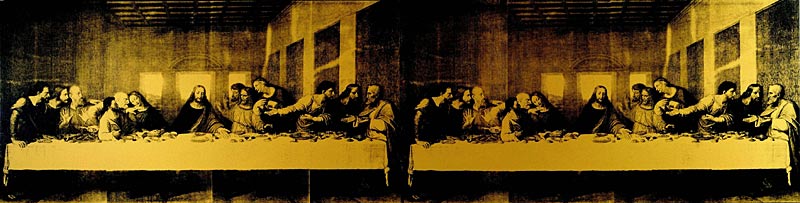
El año antes de morir —a los 58 años, en 1987—, Warhol creó más de 100 obras inspiradas en el fresco milanés “La última cena”, de Leonardo da Vinci.

“Para un artista obsesionado con la muerte, la última cena del Señor funcionaba como la pintura en la que se consumía el desastre”, dijo Joseph Ketner, que fue curador de la muestra en el Museo de Arte de Milwaukee, donde se exhibió primero. “La imagen de Cristo y los discípulos lo obsesionaban”, agregó Ketner en el catálogo de la exhibición.

Tres de las obras de “La última cena” son monumentales, con longitudes entre los 7,6 y los 10,7 metros, y una de ellas está bañada en amarillo. Otra pieza yuxtapone cuatro figuras de Cristo con un trío de motocicletas, un águila roja que desciende y una etiqueta de 6,99 dólares. El cuadro más grande tiene 112 retratos de Cristo, que recuerdan a los íconos repetidos del arte bizantino, dijo Atkins.

Los padres de Warhol, inmigrantes de Eslovaquia, lo criaron en el catolicismo bizantino, que contaba con una iglesia en el Pittsburgh natal del artista.

El giro de Andy Warhol hacia el arte abstracto, también después de los 50 años, domina la primera sección de la exposición. La influencia de las pinturas desordenadas del “action painting” abstracto de Jackson Pollock es clara en la serie “Yarn”.

Fuente: http://elcomercio.pe/impresa/notas/imaginario-religioso-warhol/20100613/494083

El lado católico y abstracto de Andy Warhol


Como pionero del 'Pop Art', Andy Warhol labró su camino a la fama con sus características cajas de jabón Brillo y latas de sopa Campbell. Sin embargo, una nueva exposición muestra que el arte pop apenas fue una fase de siete años del artista en los años 60, antes de zambullirse en la década de 1980 en el arte abstracto y la imaginería cristiana, particularmente en sus versiones de 'La última cena'.

Frívolo, descarado y extravagante como personalidad del mundo del arte, Warhol se guardó para el ámbito privado su devoto catolicismo durante mucho tiempo.

"Sólo sus más estrechos confidentes sabían que era una persona religiosa y que iba con frecuencia a misa", dijo Sharon Matt Atkins, comisaria de la exposición 'Andy Warhol: The Last Decade' en el Museo de Brooklyn, que se inaugura el 18 de junio.

Es poco conocido que Warhol acudía a la iglesia en el lujoso Upper East Side de Manhattan, a años luz de su famoso estudio Factory del centro, frecuentado por personas excéntricas y estrafalarias.

En la mitad de su vida, comenzó a explorar los temas religiosos en su arte

La última cena

"Después de que Warhol cumpliera 50 años, comenzó a reconsiderar su carrera", dijo Atkins. "También empezamos a ver a Warhol reflejando lo inevitable de su propia muerte", añadió.

El año antes de morir -a los 58 años, en 1987-, Warhol creó más de 100 obras inspiradas en el fresco milanés 'La última cena', de Leonardo da Vinci.

"Para un artista obsesionado con la muerte, la última cena del Señor funcionaba como la pintura en la que se consumía el desastre", dijo Joseph Ketner, que fue comisario de la muestra en el Museo de Arte de Milwaukee, donde se exhibió primero.

"La imagen de Cristo y los discípulos lo obsesionaban", agregó Ketner en el católogo de la exhibición.

Tres de las obras de 'La última cena' son monumentales, con longitudes entre los 7,6 y los 10,7 metros, y una de ellas está bañada en amarillo.

Irreverente por fuera, espiritual por dentro

Otra pieza yuxtapone cuatro Cristos con un trío de motocicletas, un águila roja que desciende y una etiqueta de 6,99 dólares, muestra de la irreverencia exterior de Warhol pero también reveladora de su espiritualidad interna, según Atkins.

El cuadro más grande tiene 112 retratos de Cristo, que recuerdan a los iconos repetidos del arte bizantino, dijo Atkins.

Los padres de Warhol, inmigrantes de Eslovaquia, lo criaron en el catolicismo bizantino, que contaba con una iglesia en el Pittsburgh natal del artista.

El giro de Warhol hacia el arte abstracto, también después de los 50, domina la primera sección de la exposición. La influencia de las pinturas desordenadas de Jackson Pollock es clara en la serie 'Yarn'.

fuente: http://www.elmundo.es/elmundo/2010/06/11/cultura/1276281129.html


Pop Art y Warhol en la actualidad


EN LIMA, MALI

El Museo de Arte de Lima no se quiere quedar atrás en la vanguardia artística luego de su reinauguración. Tras la exitosa exposición de “Portraits”, del fotógrafo peruano Mario Testino, el MALI ahora propone Por art en la capital.

La muestra reúne 58 obras de la colección del Instituto Valenciano de Arte Moderno (IVAM), producidas por 25 artistas europeos y norteamericanos (España, Inglaterra, Alemania, Francia y Estados Unidos).

Entre ellos, se encuentran Eduardo Arroyo, John Baldessari, Equipo Crónica, Juan Genovés, Alberto Greco, Richard Hamilton, Jaspers Johns, Claes Oldenburg, Richard Prince, Robert Rauschenberg, Josep Renau, Gerhard Richter, James Rosenquist, Antonio Saura, Cindy Sherman y Juan Antonio Toledo.

La muestra –que reúne óleos, acrílicos, acuarelas, serigrafías, técnica mixta, litografías, fotografías, collages, fotomontajes, linóleo e instalación- permite revisar en profundidad la producción de artistas que marcaron una senda en el arte contemporáneo de la segunda mitad del siglo XX, a partir de contextos vitales, sociales, políticos y culturales marcados por la post guerra, la guerra fría y el mercado.

Antes de su llegada a Lima, la exposición ha recorrido importantes museos de Puerto Rico, Brasil, Argentina, Chile, Cuba y República Dominicana.

La exhibición se presenta hasta el 1 de agosto de 2010 en el MALI, salas 1 y 2, de martes a domingo de 10:00 a.m. a 08:00 p.m., y sábados hasta las 05:00 p.m. (los lunes está cerrado)

fuente: http://elcomercio.pe/noticia/500719/pop-art-museo-arte-lima

Él es “Mr. América”
Sao Paulo conoció a “Mr. América”. El legado de Andy Warhol (1928-1987), uno de los mayores íconos del arte pop, llegó a Brasil con una exposición que lleva ese título y que reúne obras como sus célebres retratos, serigrafías, además de fotografía y cine. Las famosas series de serigrafías de las sopas Campbell (1968 y 1969) y las coloridas imágenes de Marilyn Monroe (1967) se roban la atención del público paulista, que puede ver los trabajos (que critican a la cultura popular estadounidense) hasta el 23 de mayo. “Sus preocupaciones coinciden extensamente con las características más salientes de la entonces naciente cultura popular: sexo, muerte, poder y celebridad”, destaca el curador de la muestra, Philip Larratt-Smith.

SAO PAULO [EFE]. La muestra “Andy Warhol, Mr. América” reúne desde ayer en Sao Paulo cerca de 200 obras del estadounidense Andy Warhol (1928-1987). Ha sido calificada como la mayor colección de obras del artista pop en Brasil.

La Estación Pinacoteca, una de las salas de exposiciones más importantes de la ciudad, expondrá hasta el próximo 23 de mayo 26 pinturas, 58 grabados, 39 fotografías, dos instalaciones y 44 películas del artista.

Entre las obras más famosas de Warhol que forman parte de la exposición figuran piezas tan memorables como los retratos de Marilyn Monroe o Elizabeth Taylor, los autorretratos multicolores del artista y el tradicional dibujo de la lata de sopa Campbell’s.

Aun así, la exposición pretende mostrar el lado más crítico de Warhol con la política estadounidense y el carácter sarcástico de sus obras.

El retrato de Marilyn Monroe, representada con un maquillaje extremo y casi grotesco, lleva la obra de Warhol más allá de la simple etiqueta de “artista pop”.

La lata de sopas Campbell’s no solo quiere llamar la atención con colores chillones y visualmente atractivos, sino que pretende lanzar una crítica a la superficialidad y el consumismo de la América de posguerra. Sarcástico y provocador, Warhol llenaba algunas de sus obras de referencias sexuales no explícitas, pero sí suficientemente claras para provocar al público más conservador de la época, como en el corto “Blow Job”, en el que se muestra la cara de un hombre a quien le están haciendo una felación.

Destaca también el corto “Empire”, una versión reducida de una grabación de 50 minutos en la que Warhol retrata la grandeza del imperio americano con imágenes del Empire State Building.

La exposición “Andy Warhol, Mr. América” empezó una gira sudamericana el año pasado en Bogotá, siguió por Buenos Aires y terminará su recorrido en Sao Paulo.

fuente: http://elcomercio.pe/impresa/notas/lado-critico-pop-art/20100321/449755


AUTORETRATO

Nueva York (EFE). Uno de los últimos autorretratos del artista estadounidense Andy Warhol, realizado en 1986 y valorado entre 10 y 15 millones de dólares, saldrá a la venta el próximo 12 de mayo en Nueva York, informó la casa de subastas Sotheby’s.

Un portavoz de la firma indicó que se trata de una obra de arte “icónica y rara” del artista estadounidense (1928-1987) y que pertenece a la serie de autorretratos que pintó en los ochenta, considerados, además, entre las piezas más importantes de su carrera.

“Es un óleo monumental de 2,74 metros y uno de los dos que están en manos privadas”, precisó la fuente, que también señaló que la obra, realizada en tonos púrpuras, y en la que el artista mira directa e intensamente al observador, será expuesta en las instalaciones de la firma británica en Hong Kong y Londres antes de ser vendida en Nueva York.

IMPORTANTE EN LA OBRA DEL ARTISTA
Según la casa de subastas, este autorretrato de Warhol realizado sobre un fondo negro y con la cara del artista en tono púrpura “es un raro ejemplo de un tema importante en la obra del artista, como la complicada dicotomía entre lo público y lo privado”.

Durante la década de los sesenta, Warhol realizó algunas de las obras más importantes del arte pop en las series de retratos de artistas como Marilyn Monroe, Elvis Presley o Elizabeth Taylor, y que utilizó “como vehículo para explorar temas como la mortalidad o la universalidad de la cultura popular”, señaló la firma.

UN AÑO ANTES DE SU MUERTE
Esta obra pertenece a la serie de autorretratos que el artista realizó en 1986, un año antes de su muerte en febrero de 1987, y se basan en fotos que tomó de sí mismo con una cámara instantánea Polaroid, un instrumento del que se sirvió con frecuencia para sus trabajos durante los setenta.

En los sesenta el artista estadounidense también había explorado a través de otra serie de autorretratos sus inquietudes relacionadas con la celebridad, la vulnerabilidad y la muerte.

Otros autorretratos de menor tamaño del artista nacido en Pittsburg (Pensilvania) están precisamente en el museo de esa ciudad que lleva su nombre, en concreto las versiones azul y amarilla, mientras que la verde está en las salas del museo de Arte Moderno de Fort Worth (Texas) y la roja pertenece a un coleccionista de EE.UU.

fuente: http://elcomercio.pe/noticia/450435/autorretrato-andy-warhol-realizado-ano-antes-su-muerte-se-subastara-mayo

Una de las características del arte contemporáneo de la que más espectadores podrán dar fe es su capacidad para dejarnos perplejos. Perplejidad que, muchas veces, viene en la forma de la pregunta “¿esto es arte?”. Es por eso que lo que se va a exponer en el Museo de Arte de Lima a partir de este viernes resulta importante. Si bien la muestra “Pop Art en la colección del IVAM” no es la solución a todas las perplejidades, sí nos ofrece, a través de las obras de reconocidos maestros de diversas nacionalidades, una entrada para empezar a comprender la complejidad del arte contemporáneo. Y es que en el pop art podemos hallar varias de las primeras manifestaciones de eso que tantas veces nos confunde ahora, como la intención de borrar el estilo personal del autor, la reelaboración de imágenes de la cultura de masas o el intento por borrar las fronteras entre lo que es arte y lo que no lo es.

El Instituto Valenciano de Arte Moderno (IVAM) posee una de las más importantes colecciones de arte pop de toda Europa. En ella encontramos trabajos de reconocidos maestros como Richard Hamilton, Robert Rauschenberg, Jasper Johns, Yves Klein, Sigmar Polke, Gerhard Richter, entre otros, además de importantes representantes del pop español, como Anzo, Eduardo Arroyo, Equipo Crónica, Juan Genovés, Equipo Realidad, Josep Renau, Manuel Sáez, Antonio Saura y Juan Antonio Toledo.

UNA MIRADA DISTINTA
Sí, usted debe estar pensando: “Si es una de las colecciones más importantes de pop art, ¿cómo no tiene obras de Andy Warhol y Roy Lichtenstein?”. La respuesta es que, como toda buena colección, la del IVAM responde a un criterio preciso: recoger la historia del pop en Europa y de autores de otras nacionalidades que hayan resultado influyentes para el desarrollo de esta tendencia en el Viejo Continente. Y, si bien fueron vistos y admirados, Warhol y Lichtenstein no están directamente conectados con el pop europeo. Es por eso que no están en la colección.

El pop que nos presenta esta muestra tiene mucho más carga política (como se podrá apreciar en el interesante trabajo del Equipo Crónica, por ejemplo) y menos ambigüedad con respecto a la sociedad de consumo que el pop estadounidense. Y eso resulta interesante, también, porque acerca estas manifestaciones del pop a las que surgieron aquí mismo, en el Perú. La razón para todo ello es simple: para un artista como Warhol, por ejemplo, el consumo de Coca-Cola era algo que se daba por hecho, propio de las clases trabajadoras de su país, un signo de igualdad cultural y económica que, llevado a una galería de arte, era un atentado contra la estirada alta cultura. Esa misma Coca-Cola, sin embargo, en países como el nuestro, representa lo importado y, en alguna época, inclusive un signo de estatus socioeconómico, es decir, todo lo contrario que en Warhol. Así, el modo en que el pop fue recibido y reproducido en España y en otras partes de Europa difiere de la habitual historia que de esta tendencia se cuenta, una habitualmente marcada por un sesgo anglosajón.

Pero esas son razones académicas. Lo que importa, a fin de cuentas, es que es la oportunidad para ver buen arte.

fuente: http://elcomercio.pe/impresa/notas/nueva-mirada-al-arte-pop/20100612/493636

CITAS


Tan odiado como amado, Warhol revolucionó el mundo del arte a través del Pop Art a mediados del siglo XX.
Definir a Andy Warhola, más conocido como Andy Warhol es complicado. Liz Taylor, Marilyn Monroe, Debbie Harry, Jackie Kennedy e incluso Mao fueron convertidos en iconos Pop gracias a su obra. Pero Warhol encontraba inspiración hasta en los objetos más mundanos como las sopas

Campbell o las botellas de Coca-Cola.

Empezó su carrera como ilustrador de revistas, pero no tardó en hacerse célebre gracias a su trabajo como pintor y cineasta. Entre sus películas más destacadas están Vinyl, Heat, Chelsea Girls o Poor Little Rich Girl con una de sus mayores musas, Edie Sedgwick.

The Factory, lugar de encuentro para todo tipo de artistas

Su famoso estudio, The Factory, fue lugar de encuentro a partir de 1963 de todo tipo de artistas de la escena underground de Nueva York. Fue su época más polémica debido al contenido de sus obras que aún chocaban a la sociedad de esos momentos. En 1968 incluso sufrió un intento de asesinato por parte de Valerie Solanas, una feminista radical que tenía una lista de hombres a los que “eliminar”.

Solanas le disparó seis veces, pero Warhol sobrevivió, no sin unas grandes cicatrices en su torso que más tarde Richard Avedon inmortalizaría en una de sus fotografías. Nunca superó el trauma de ese ataque por parte de una conocida suya. Durante los años 70 es contratado por celebridades del mundo entero para que les retrate, en España, por ejemplo, fue Miguel Bosé quién quiso que Warhol lo retratara para la portada de su disco Made In Spain.

Lenin y Mao Tse Tung, sus últimos retratos

Entre los años 1972 y 1986, Warhol realizó unos mil retratos, lo que supone haber creado casi uno por semana, la mayoría por encargo, una curiosidad es la tarifa única de 25.000 dólares que cobraba por cada uno. Lenin y Mao Tse Tung fueron los últimos retratos que pintó Warhol en 1986, un año después moriría repentinamente a los 58 años tras un ataque al corazón.


Su legado le sobrevivirá siempre, ya que su obra, no solamente marcó un antes y un después en el mundo del arte, además sirvió de inspiración para todo tipo de artistas, desde músicos hasta cineastas. La figura de Warhol, permanecerá eternamente en los libros de arte como la figura de un genio no siempre comprendido.

A pesar de la superficialidad que siempre ha caracterizado su obra, sin entrar en temas profundos, Warhol era un personaje con una gran personalidad y unas ideas tan radicales como su postura estética, a través de sus entrevistas y libros se puede llegar a conocer el interior del artista. Warhol nunca morirá porque la atemporalidad de su obra le mantendrá siempre vivo, como el mismo decía "no creo en la muerte porque uno no está presente para saber que, en efecto, ha ocurrido".

Salvador Dalí, entre las personalidades que pasaron por su estudio

En la quinta planta del número 231 de la calle 47 Este en Midtown, Manhattan, tenía su sede The Factory, el mítico estudio del gran Andy Warhol. Algunas de las personalidades que pululaban por allí eran The Velvet Underground, especialmente Lou Reed, Nico, Mick Jagger, Bob Dylan, Brian Jones, Fernando Arrabal, Allen Ginsberg, Salvador Dalí, Truman Capote…

Pero también había un amplio elenco de asiduos que prácticamente hacían vida allí: Edie Sedgwick, Paul Morrissey, Joe Dallesandro, Candy Darling, Anita Pallenberg, Billy Name, Hoody Woodlawn, Jackie Curtis, Joe Campbell, Gerard Malanga, Ondine… Desde fotógrafos hasta actores porno, pasando por drag queens, idealistas, escritores, músicos, drogadictos, modelos… Las puertas de Warhol siempre estaban abiertas a cualquiera que pudiera aportarle algo.

Expresión vanguardista ya fuera en cuadros en películas

Eran comunes las orgías en The Factory, pero también las colaboraciones entre muchos de los asiduos para crear arte, ya fuera en forma de cuadros o películas. Andy y sus compañeros experimentaban con todo, descubriendo nuevas formas de expresión vanguardistas. La conocida como Silver Factory, por tener las paredes llenas de estaño y espejos rotos, vivió sus mejores años en los 60, hasta el atentado de Valerie Solanas (otra asidua del lugar) a Andy Warhol.

Después The Factory cambió su ubicación a la sexta planta del número 33 de Union Square Oeste, pero su momento de esplendor ya había pasado. El ambiente creativo y revolucionario de The Factory y sus habitantes había muerto. Andy nunca se recuperó del trauma causado por Solanas y eso era algo que impregnaba su vida posterior.

Fuese como fuese, en los años 60 el underground tuvo un lugar de culto donde reunirse, unirse y crear algunos contactos importantes y fructíferos para el arte y la cultura posteriores. Solamente debemos escuchar el “Walk on the wild side” de Reed para cerrar los ojos y trasladarnos allí, un tema que el músico dedicó a Warhol y sus amigos de The Factory.


Fuente: http://arte.suite101.net/article.cfm/andy-warhol#ixzz0sBqGul2p

Biografía: Dibujante, pintor, cineasta, fotógrafo, productor musical y empresario estadounidense, considerado el fundador y la figura más relevante del llamado Pop Art y el artista norteamericano más influyente de la segunda mitad del siglo XX. De padres inmigrantes eslovacos, Andy Warhol fue el tercer hijo de la familia. Su infancia estuvo marcada por largos periodos de convalecencia por padecer escarlatina y creó un fuerte vínculo con su madre, además de aprovechar el tiempo pintando y dibujando. Tras la muerte del padre, la familia vivió al borde de la miseria. En 1945 Andy Warhol ingresa en el "Instituto Carnegie de Tecnología", donde cursa estudios de diseño y recibe una formación artística orientada hacia el comercio. Tras graduarse en 1949 se traslada a Nueva York y adopta el nombre que lo hizo famoso (su nombre real era Andrew Warhola), marcando el punto de partida de su carrera. Ya instalado, Andy Warhol comienza a trabajar en revistas de moda como "Glamour", "Vogue" y "Tiffany & Co" como ilustrador comercial y logra una ansiada seguridad económica. Paralelamente comienza a desarrollar su obra, celebrando la primera exposición individual en una galería de Nueva York en el año 1952. En 1956, Andy Warhol gana un premio por logros destacados de parte del Museo de Arte Moderno de Nueva York (MoMA). En 1960 comenzó a pintar cuadros de productos famosos y personajes de tiras cómicas, intentando cambiar su imagen de artista comercial a artista de bellas artes. En 1663 funda el estudio "The factory", mezclando diseño publicitario y arte de vanguardia, revolucionando el mundo del arte y popularizando su trabajo y dos años después representa al grupo musical "The Velvet Underground" liderado por Lou Reed, dejando de tener relación con ellos en 1667. En 1968 la escritora feminista radical Valerie Solanas, a quien Andy Warhol le había prometido publicar un texto en su revista, le dispara varias veces hiriéndolo de gravedad, lo que le obligó a estar hospitalizado durante varios meses. A partir de 1970 se consagra como estrella del arte, haciendo cuadros para artistas famosos y siendo contratado por varias fábricas de automóviles para decorar sus vehículos. En 1980 el arte de Andy Warhol sufre un giro y se hace más abstracta, pero rica pictóricamente y con mayor complejidad visual. Fallece en 1987 por complicaciones luego de una operación.


Frases de Andy Warhol

Toda pintura es un hecho: las pinturas están cargadas con su propia presencia. Pintura

El arte comercial es mucho mejor que el arte por el arte. Arte

En el futuro todo el mundo será famoso durante quince minutos. Todo el mundo debería tener derecho a 15 minutos de gloria. Famoso

En los años ochenta va a haber cada quince minutos un nuevo futuro. Futuro

La inspiración es la televisión. Televisión

No creo en la muerte porque uno no está presente para saber que, en efecto, ha ocurrido. Muerte

Un artista es alguien que produce cosas que la gente no necesita tener pero que él, por alguna razón, piensa que sería una buena idea darles. Artista

No preste ninguna atención a lo que escriben de usted. Valórelo en pulgadas. Valor

Creo en las luces tenues y los espejos trucados. Espejo

Nunca leo, veo las imágenes. Imagen

Me temo que si uno fija su atención en una cosa el tiempo suficiente, pierde todo su significado. Tiempo

He decidido algo: comerciar cosas realmente fétidas. Enseguida se convertirían en éxito en un mercado masivo que realmente apesta. Mercado

Si quieres saber todo sobre Andy Warhol, basta con ver mis pinturas y películas y allí estoy. No hay nada más. ¿No es la vida sólo una serie de imágenes que cambian a medida que se repiten? Peliculas

La gente debe enamorarse con los ojos cerrados. Sólo cierra los ojos. No veas, y será mágico. Enamorarse

¿Por qué la gente piensa que lo artistas son especiales? Es sólo otro trabajo. Artista

El arte es lo que dejas salir. Arte

La idea no es vivir para siempre, es crear algo que sí lo haga. Crear

Morir es la cosa más embarazosa que puede suceder, porque alguien tiene que cuidar de todos sus detalles. Morir

Tengo una enfermedad social. Tengo que salir todas las noches. Enfermedad

Nunca pienso que las cosas mueren. Simplemente van a grandes tiendas. Muerte

Si buscas algo el tiempo suficiente, pierde todo su significado. Buscar

Las atracciones más interesantes son entre dos opuestos que nunca se encuentran. Interesante

fuente: http://www.frasesypensamientos.com.ar/autor/andy-warhol_2.html


jueves, 24 de junio de 2010

Nico Williams


NICO: “NICO”

“El silencio de tus alas, la belleza que aportas, un beso antes de morir, un beso antes de llorar.” - The Cult , Nico


Christa Päffgen, más conocida como Nico nació en Alemania, 16 de octubre de 1938. Fue una cantautora, modelo y actriz alemana. Es famosa tanto por su colaboración con The Velvet Underground, como por su trabajo como solista.
Si bien es más conocida por su trabajo musical, también tuvo un pequeño puñado de papeles en el cine, incluyendo una pequeña aparición en la aclamada película de Federico Fellini de 1960, La Dolce Vita. Fue amiga cercana y colaboradora artística de Andy Warhol, por lo que también actuó en varios papeles en sus películas de arte experimental, especialmente Chelsea Girls, lo cual la inspiró después a titular su álbum debut.
En agosto de 1967 Jim Morrison dejó momentáneamente a Pamela Courson y se lanzó a una apasionada relación con Nico, quien se enamoró profundamente de Jim, a tal punto de vivir asustada por la intensidad de sus sentimientos. Jim le habló de su fijación hacia las chicas pelirrojas y Nico se tiñó el cabello rubio pálido por un brillante color rojo semejante al fuego. Cuando Jim vio el resultado se puso a llorar.
Jim y Nico solían escaparse al desierto por las noches. Allí emprendían juntos viajes con ácido. Ella le pidió a él que le propusiera matrimonio; Jim se rió tanto que se cayó de la silla donde estaba sentado. Nico lo golpeó.
Las letras que los dos amantes escribieron se convirtieron en parte del soberbio álbum de Nico “The Marble Index” (1969). Nico no estaba segura de sus creaciones, porque siempre había cantado canciones de otros y le suponía una dificultad extra escribir en un idioma extranjero. Pero ganó confianza con la aprobación de Jim.
La tórrida relación de Jim y Nico duró sólo algunas semanas. Jim regresó con Pamela. Nico se tiñó el cabello con un tono rojo aún más intenso.
Años más tarde, cuando Nico supo que Morrison había muerto, se deprimió mucho. Compró todos los periódicos de París y de Londres y lloró cuando leyó los reportajes. No lo podía creer. Semanas antes se había quedado conmocionada al ver a Morrison en un auto por las calles de París, con el rostro hinchado y la mirada perdida. Cuando dejó de llorar, entró al cuarto de baño y procedió a quitarse el tinte rojo del cabello. Le llevó varios días de lavado para que su pelo volviera a su color rubio natural. Luego se lo tiñó de negro, color que llevaría por muchos años.
Nico también fue novia de Brian Jones. Tuvo un hijo a Alain Delon, aunque él nunca lo reconoció oficialmente, inspiró a Bob Dylan, inició en el sexo oral a Iggy Pop, fue amante de Lou Reed y volvió loco de amor a Leonard Cohen, al que nunca correspondió.
El 18 de julio de 1988 Nico se cayó de su bicicleta mientras paseaba por Ibiza y se golpeó la cabeza. Un taxista que pasaba por allí la llevó a un hospital cercano donde tuvo dificultades para ser atendida. Una vez en el hospital fue erróneamente diagnosticada con insolación y falleció al día siguiente de derrame cerebral. Sus cenizas fueron sepultadas junto a las de su madre, Margaret Päffgen, en Berlín, en un cementerio en el medio de un bosque. Unos pocos amigos la despidieron con una cinta en la que sonaron canciones suyas.
“Nico” es una canción publicada por The Cult en su álbum Beyond Good And Evil (2001). “Vi volar tu espíritu a través del cielo de terciopelo, los secretos que ocultar. Estoy perdido, dentro de tu dulce beso. Hey Nico (Nico). La vida que te perdiste.”

Otras canciones inspiradas en Nico:

-“A Song for Nico” ('Time Kissin, 2002) - Marianne Faithfull: “Y cuando Brian Jones está cerca Nico no se siente tan rara.”

-"Those Girls (Song For Nico)" (A Lifetime of Temporary Relief: 10 Years of B-Sides and Rarities, 2004) - Low

-"Dance, Dance Christa Päffgen" (Never Take Friendship Personal, 2005) – Anberlin: “Las temperaturas suben y empiezo a moverme. Eres tú que estás corriendo por mis venas.”

- “La Dame Et La Licorne” (Palo Santo, 2006) -Shearwater


Fuente: http://todosobrelosabrazosrotos.blogspot.com/search/label/ANDY%20WARHOL


Who is Nico Williams?

Sotheby's in London is selling a painting by Andy Warhol whose subject may have been wrongly identified in their upcoming Contemporary Art Day Auction in London on June 29th. Lot 303 of the auction is listed as "Untitled (Nico Williams)." In their listing, Sotheby's includes a description of Nico, the lead singer from the Velvet Underground, even though Nico was not known to have the surname of Williams. It's as though the person naming the subject of the portrait has confused Nico with the Velvet's lighting person, Danny Williams, and has come up with "Nico Williams." Despite this, the picture is expected to sell for 180,000 to 250,000 pounds (or 262,044 to 363,950 U.S. dollars).

The picture can be seen at:
http://www.sothebys.com/app/live/lot/LotDetail.jsp?lot_id=159602908.

The provenance and exhibition history of the painting is somewhat limited. The painting was not exhibited until well after Warhol's death and apparently only in Italy. According to the information on the Sotheby's website, in 2006 it was shown at the Museo Civico Archeologico in Bologna and the following year in an exhibition titled "Made in Warhol" at Lake Maggiore, Italy. It was also included in art dealer Tony Shafrazi's book Andy Warhol Portraits.

The portrait was originally from a private collection in Germany and was "acquired directly from the artist in 1981"- the year it was painted. Warhol generally worked from Polaroids which he shot himself of his subject when doing the commissioned portraits. By 1981 Nico was considerably overweight and did not resemble the woman in picture. It would have been highly unusual for Warhol to do a portrait in 1981 based on a photograph from the 60s. One would have thought that the person who acquired the painting directly from the artist in the year it was painted would be the same person who commissioned the painting, but that doesn't appear to be the case here because of it's "Untitled" title. Someone other than Warhol has presumably identified the subject as "Nico Williams" but who was Nico Williams?

Fuente: http://www.warholstars.org/


Warhol as a flim maker

The following article on Andy Warhol first appeared in the May/June 1971 issue of Art in America (vol. 59 no. 3). The author, David Bourdon, would later write Warhol,one of the most respected biographies of the artist. (Unlike many books on Andy Warhol, Bourdon's book is fully footnoted and indexed, making it particularly useful for academic research.) The original article included stills from the films and the following photo taken by John Chamberlain. (Issues of this magazine are occasionally sold on ebay.)


WARHOL AS FILMMAKER
by David Bourdon

Far from being a neutral and impassive recorder of daily life, or a cinematic journalist documenting present-day depravity, Andy Warhol has constructed a stylized, extremely interpretive view of contemporary life that, however real it might seem on screen, is closer to fantasy than to any kind of reality with which most of us are familiar.

More talked about than seen, more emulated than admired, Andy Warhol's films will probably survive as legends rather than as living classics that people will want to see again and again. Currently, there is a fairly broad consensus that he is among the most important, provocative and influential filmmakers of the sixties. To the general public, he is best known as the originator of the marathon motionless movie, whose petrified camera dutifully records an inactive image, and as the purveyor of voyeuristic nudity, obscenity, homosexuality, transvestitism, drugs and various other X-rated activities.

But to art and cinema connoisseurs Warhol has scored many conceptual coups and stylistic innovations: some see him as a "primitive" who has taken cinema "back to its origins, to the days of Lumiere, for a rejuvenation and a cleansing" (Jonas Mekas); others see him as an especially gifted recorder of "the seemingly unimportant details that make up our daily lives" (Samuel Adams Green). A lot has been made of how scrupulously he records ordinary events "as they are," and of his beneficent inclination to let his performers just "be themselves." Finally, there has been a great deal of emphasis on his equation of real-time with reel-time - if it takes a man three minutes to eat a banana, that slice of life is filmed and projected for three minutes without cuts. But far from being literal transcriptions of reality, Warhol's films are more inventive, artificial and art-directed than some of his admirers would like to believe.

Warhol made his debut as a filmmaker with fortuitous timing. Being familiar with avant-garde painting, sculpture, music and dance, he was able to approach film with a broader and more sophisticated outlook than was available to most "underground" filmmakers. Some of his initial experiments in 1963 were with single-frame shooting (photographing one frame at a time with a hand-held camera) a stylistic technique already employed by several independent filmmakers, such as Stan Brakhage, Gregory Markopoulos and Taylor Mead. But he soon realized that long takes were the antithesis of what was by then an accepted convention and so he began making "motionless" movies. Bringing movies to a standstill had less to do with investigating the fundamental nature of film than it had to do with the exploration of a then-emerging esthetic - the Minimalist esthetic. He had already experimented with monotony in paintings made up of images identically repeated in regimented rows; and his Minimalist inclinations were reinforced by his awareness of several musical works: John Cage's notorious "silent" composition, 4' 33"; La Monte Young's "eternal" drone music; and the eighteen-hour performance in 1963 of Erik Satie's Vexations, an eighty-second piano piece repeated 840 times.

The first phase of Warhol's quasi-fantastic vision was of a spaced-out, slow-motion world in which people really do sleep eight hours, while others devote nearly as much time to such lethargic inactivities as eating a mushroom or smoking a cigar. This is a silent world, rendered in contrasty black-and-white, and stripped of any incidental interest and climax. It is usually inhabited by a single performer, seen frontally and in close-up, whose luxury and torment it is to while away an eternity of time on some simple, relatively meaningless task. The camera is stationary, the image seldom varies within the frame, and any movement, action or facial expression is decelerated to such a sluggish pace that it begins to exert a trancelike effect on the viewer - who, like the person on-screen, feels victimized by torpor. The effect is of a microscopic detail that is senseless in itself but acquires significance through magnification and persistence. Staring at the immobile and inexpressive face on screen, the viewer may think of all the worthwhile things he should be doing instead of sitting here bored out of his mind. Suddenly, the face on screen is charged with melodrama; the performer has uncontrollably blinked or swallowed, and the involuntary action becomes a highly dramatic event, as climactic in context as the burning of Atlanta in Gone with the Wind. (Warhol once said his best actor was someone who blinked only three times in ten minutes. Question: Aren't you confusing blinking with acting? Warhol: Yes.)

The notion of introducing stillness to movies was a radical idea. No one had to see Sleep to be provoked by the very concept of such a movie. The fact that Warhol's early films are still talked about more than they are seen can be interpreted as their strength, demonstrating the power of the idea, or as their defect, suggesting they do not transcend the idea. However, anyone who has actually sat through the films knows how words fail to convey the experience. Consequently it would be wrong to say that Warhol's films are so conceptual that they can be adequately described or experienced in words.

After the outraged reception of Sleep, Warhol deliberately set about filming movies of exaggerated length. In most movies, time is compressed so that lengthy activities appear of much shorter duration; but in a Warhol movie, inconsequential activities are prolonged so that the minutes seem to drag like days. To begin, with, the duration of the filmed action was totally artificial. Who in his right mind spends forty-five minutes eating a mushroom? Warhol instructed his performers to remain as motionless as possible, and to prolong their actions as long as possible. To stretch out the time even further, Warhol frequently films the scene at sound speed (twenty-four frames per second), then projected it at silent speed (sixteen frames per second), so that whatever movement the image might be capable of was shown in protracted slow motion. "When nothing happens, you have a chance to think about everything," Warhol explained.

The second phase of Warhol's vision began in 1963, when he started experimenting with sound, color, camera movement, action, narrative and editing. In this phase, the performers became interesting as personalities. Warhol presented a highly selective gallery of gorgeously gaunt, stylishly garbed and imaginatively barbered young men and women who languorously display themselves, but seem reluctant to put their often appealing bodies to any constructive or even self-satisfying use; they spout tedious monologues, as if unwinding from some pent-up paranoia that can be dispelled, or maintained, only through the recital of all their problems, past and present. These sometimes droll, sometimes pathetic monologists seem quagmired in unsatisfactory roles or situations, and apparently the only way they can sustain their gossamer fantasies is by trying to convince us of their veracity. But their self-image is askew and, like some manic individual striving to keep a grip on reality, they maintain an obsessive stranglehold on their only audience - the camera. Their whole world threatens to slide into oblivion at any moment, and even the riveting gaze of the camera cannot seem to secure it.

The manufactured chitchat and confessional soliloquies seem endless. During the screening of Sleep, members of the audience sometimes ran up to the screen and yelled in the slumbering man's ear: "Wake Up!" The interminable chatter in the later movies makes people want to scream: "Shut up!" But suddenly, the interminable story trails out in mid-sentence, just a few words before the possible punch line, as the over exposed and lank end of the reel passes through the projector. We are left wanting to know the conclusion of the monologue we could not bring ourselves to listen to. We are made to feel the regrettable transience of what had seemed an excruciating boring scene. Those ridiculous people with their tiresome sagas emerge in retrospect as poignant creatures who deserved more of our sympathy and attention.

The feeling of impermanence is one of the strongest impressions left by Warhol's films. No matter how static the image, no matter how lengthy the monologue, no matter how tedious and unendurable the movies seem while we watch them, we are left with a sense of their brevity.

Even the physical record of Warhol's cinematic achievement is beginning to look impermanent. From 1964 through 1967, Warhol's film production was prodigious. Scores of movies were shot, but entire reels and projects were abandoned, and only what was felt to be successful was publicly shown. No authoritative record was ever kept of titles, dates, number of reels, cast and collaborators. Reconstructing the data now is largely a matter of guesswork, although a few attempts have been made to catalogue the oeuvre. The studio film library presently consists of miscellaneous cans of prints randomly stacked in steel cabinets at the rear of the Factory. (Warhol has put the original films in storage, where they are probably in even greater disorder.) Nevertheless, many of the films have been damaged, or have totally vanished; even the original print of Sleep is missing. In other cases, such as the twenty-five-hour-long **** (Four Stars), cans of films are present, but nobody has any idea in what sequence they were originally shown. The casual attitude toward shooting the movies carried over into their projection. Even in regular screenings at commercial theaters, the reels were inexplicably jumbled, or one reel was deleted from one showing but not the next, leading to such wholesale variations that some reviewers began citing the date and hour of the performance they had attended. It is unlikely that very many of the films will ever be accurately reconstructed as they were originally screened - which is symptomatic of the "benign neglect" with which Warhol treats all of his work.

From the beginning, Warhol was a shrewd and canny photographer who knowingly got the effects he wanted. He expended considerable thought and effort on the proper lighting, angle and setup. In the early movies, he favored strong sidelighting with harsh shadows, and most often concentrated on the frontal image (the most informative and iconic angle), which he centered and tightly framed. Once he had a satisfactory setup, he could turn on the camera's motor and walk away. Later he experimented with zooms and pans. "His zooms are perhaps the first anti-zooms in film history," according to to Andrew Sarris, for whom "Warhol's zooms swoop on inessential details with unerring inaccuracy." They seldom correspond to any ostensible narrative or presumed story-line, and seem deliberately inattentive to the on-screen action, often missing significant moments. During the shooting of one scene of Lonesome Cowboys in Old Tucson, Viva was nearly urinated upon by her antagonist's horse and then, losing her footing in the mud and falling against the hind legs of her own horse, nearly trampled upon. Warhol missed both events because he was zooming in on a storefront sign across the street.

The sound in Warhol movies, though steadily improving, is still below professional standards. Warhol claims that the bad sound was at first done deliberately, because clear sound was too expensive. More likely, good sound was never really considered a desirable virtue. When Sleep was first shown, the accompanying sound was provided by two transistor radios on stage, tuned to different rock stations. When Warhol was invited to show four films at the 1964 New York Film Festival, he commissioned La Monte Young to compose a taped soundtrack that could be used for all four - the droning sound of a bow being played over a brass mortar. Now that Warhol turns the camera off and on during a sequence, he does it without regard for what the performers are saying, so that dialogue is arbitrarily punctuated and blipped without concern for content.

At first, Warhol refused to do any editing. Entire reels might be deleted, but there were no internal cuts within a reel. All the reels were spliced together, end-to-end, including the blank film leader, so that the image was interrupted every three minutes or so by over-exposed reel ends, and then flashes of clear light, which became a kind of dynamic interlude between sections of the static image, giving a sense of structural rhythm to the film. Later, he began turning the camera off and on during a sequence to make the film look cut and also, he says, "to give it texture." Purists, who admire the unedited reality of early Warhol, are distressed that he now stops the camera. "Since everyone says I never stop the camera," Warhol said, "I stop it now, start and stop, and that makes it look cut." To make certain it looks cut, he does not splice out the frames of blank film between scenes that a professional filmmaker would delete. Consequently, when the movie is shown, there are intermittent white flashes, accompanied by a screech on the soundtrack. The strobelike effect has been dubbed the Warhol "strobecut," although technically it is not a cut at all. Like the zooms, the strobecuts do not necessarily relate to anything at all on-screen, but they often make us suspect something has been deliberately eliminated or censored. For the past few years, real editing has been performed on Warhol films in a attempt to make the movies faster-paced and more entertaining.

Over the years, scores of people have contributed their ideas and services to Warhol's movies. In addition to being unusually receptive to other people's suggestions and talents, Warhol has always demonstrated an unstinting willingness to let others collaborate with him. The most enduring and therefore most important collaborator is Paul Morrissey, an independent filmmaker until he joined forces with Warhol in 1965. Morrissey served as executive producer, scriptwriter, editor, one-man crew and business manager, and in 1968 began making his own movies under the aegis of Andy Warhol Films, Inc. Morrissey's influence on Warhol productions has been stabilizing and conventionalizing. Under his guidance, there has been a greater emphasis upon narrative (erotic stories with "redeeming social value"), technically competent camera work and sound, better-paced editing - and more routine ambitions. Morrissey's own films, Flesh and Trash, are slick, formularized versions of Warhol's films - but more professional, and more entertaining. Both Flesh and Trash have achieved commercial success.

"My influence was that I was a movie person, not an art person," says Morrissey. "An art person would have encouraged Andy to stay with the fixed camera and the rigid structure. Andy's form was extremely stylized, and people though the content was very frivolous. My notion was that the content is what is said by the people and how they look. The emphasis now is less or very minimally on the form and all on the content. And of course modern art is completely concerned with form and the elimination of content. In that sense, Andy is completely against the grain of modern art, and more in the tradition of reactionary folk art. You can only be a child so long and be revolutionary, and Andy served his apprenticeship as a revolutionary in the art world and in the movie world. But it's pathetic to see a person not develop and not grow."

Although schematic plot outlines are usually decided upon in advance, Warhol's performers are expected to improvise their own dialogue. "Professional actors and actresses are all wrong for my movies," says Warhol. "They have something in mind." According to Morrissey, it is television that has eliminated the necessity of speaking written lines in front of the camera. He marvels that movie actors are able to speak freely on television talk shows, yet freeze before a movie camera because they are unaccustomed to working without a script. There is complete unanimity in the Warhol company that performers should be capable of making up their own lines. "How can people read other people's words?" Warhol asks. "It sounds so phony." Morrissey, who is more doctrinaire, declares, "If an actor can't make up his own lines, he's no good." Viva, a supreme monologist who describes herself as "the last dying gasp of verbosity," reminds listeners that "Mae West also wrote her own lines." As Viva puts it: "Men seem to have trouble doing these non-script things. It's a natural thing for women and fags - they ramble on. But straight men are much more self-conscious about it."

It is sometimes assumed that Warhol simply pushes people in front of the camera and "lets them be themselves." This impression is seemingly corroborated by his statement quoted by Gene Youngblood: "I leave the camera running until it runs out of film because that way I can catch people being themselves. It's better to act naturally than to set up a scene and act like someone else. You get a better picture of people being themselves instead of trying to act like they're themselves."

But very few people manage to be "themselves" in front of a camera. Warhol lets his performers be "themselves" in roles that correspond to their own characters. He selects people whose looks and personalities almost - but not quite - coincide with the characters he wishes to create. Most often, it is the discrepancies in the the behavior of a person trying to impersonate someone similar to himself that register most vividly. Warhol has a ringmaster's ability to make his egocentric superstars expose their private selves. But his most diabolical ploy comes into effect when he deliberately goes one step too far, by asking the performer to do something that the performer thinks is degrading or contrary to his nature - for instance, getting slapped around, or fondling someone of the opposite sex.

"People always think that the people we use in our films are less than something," says Morrissey. "Actually everybody we use has to be a thousand times extra to stand up to our kind of filmmaking. Our people are more than actors.."

Perhaps the only viable generalization that can be made about Warhol's people is that they do not represent a broad cross-section of Middle America. The range of personality types is surprisingly narrow, and apparently conforms to certain Factory stereotypes. The male roles generally fall into three groups: (1) handsome brutes with splendidly faceted face planes and good muscular definition (Joe Dallesandro, Louis Waldon, Tom Hompertz); (2) raunchy but comical homosexuals who talk as if they had ravenous appetites for sex and drugs but look physically incapable of obtaining either (Taylor Mead, Ondine); and (3) transvestites (Mario Montez, Candy Darling, Holly Woodlawn). The female roles are only slightly more typical: (1) idealized, immaculate beauties who do not have much to say (Nico, Edie Sedgwick); (2) bawdy beauties who talk too much (Viva, Jane Forth); and (3) overweight and overstimulated grotesques (Brigid Polk, Lil Picard, Tally Brown). Most of the characters depicted in Warhol's movies exist on the fringe of society, being societal dropouts or rejects who go on having middle-class values and aspirations. They are not even good at what little they can do. The best-looking men tend to be impotent, and the best-looking women had trouble bedding any man at all. And the transvestites are tacky, with make-do hairdos, runs in their stockings and no falsies.

Often condemned for advocating nudity and homosexuality in his movies, Warhol now finds himself scorned by a younger generation which demands even more sexual liberation. He has managed to antagonize both the Women's Lib and Gay Liberation movements, which lump him among their many reactionary foes. According to Morrissey, "Andy is despised by Gay Liberation and the Women's Revolt, whatever it is, because Andy just presents it and doesn't take a position. An artist's obligation is not to take a position ever, just to present. Andy's basic position on every subject, if he has any, is comical. The absence of a position necessitates a comical attitude to make it bearable. And the most serious position a person can take is the frivolous position."

Warhol recently completed a film on the subject of Women's Lib that will not endear him to that movement, because the cast is comprised almost entirely of transvestites, at least one of which impersonates a lesbian. Around the Factory, this role reversal is considered quite amusing. "It's hard for Andy or any of the female impersonators to put down the movement," says Morrissey, "because it's a subject that neither Andy nor any of the female impersonators have the vaguest notion about. I don't know anything about it either. I hear a little bit about it on the talk shows - equal pay, etcetera, blah blah. But the logical extension of what they obviously want is to be a man, so why not have men represent them?"

Warhol's interest in film appears to be fading: he is less productive and his few film projects are less ambitious. It is difficult to determine whether his present lethargy is a temporary rest period, or a lasting consequence of the monstrous murder attempt of 1968. He exhibits almost none of the creative drives and ambitions that motivated him before he was gunned down. Despite his camerawork on Blue Movie and the unreleased Women's Lib movie (the last films he has photographed himself), he increasingly presents himself as an executive producer, a remote movie mogul whose chief interest is the supervision of an efficient and profitable production company. (Jed Johnson, an intensely quiet young man from California, who has worked at the Factory for three years, now edits and photographs some of the new films.) But when Warhol is not gloating over his supposed retirement from active movie-making, he makes vague murmurs about wanting to do something experimental again.

For a few years in the mid-sixties, Warhol displayed such incredible energy, produced so many paintings, sculptures and movies, that it seems almost unreasonable to expect more from him. From 1964 to 1967, he went through a rapid turnover of cinematic styles - from the stately Giottoesque stability of the early films, to the baroque superimpositions of the middle period, to the episodic sex narratives that culminated in the suppressed Blue Movie. In his early films, Warhol deliberately innovated certain conventions for extending and redefining our notion of reality through his unique treatment of the duration of time. But to my mind, the later works are more vibrant, intellectually more challenging and visually more satisfying. His camerawork reached a creative height in **** (Four Stars) with superb color photography and brilliant in-camera editing that he has not yet surpassed.

It is a tribute to his originality that his films have had an overwhelming effect upon an entire generation of younger experimental filmmakers, and that they have also had an influence upon such strongly individualistic filmmakers as Jean-Luc Godard, Agnes Varda, Norman Mailer and Shirley Clarke. But more important than the matter of influences is the fact that from the hundreds of reels that passed through his camera there emerged so many dazzling images and memorable scenes - a fragmentary but nonetheless valuable contribution to cinematic art.


Fuente: http://www.warholstars.org/warhol/warhol1/andy/warhol/articles/bourdon/bourdon.html